The Room That Works Three Jobs: Inside 2026’s Companion-Audio Set Builds
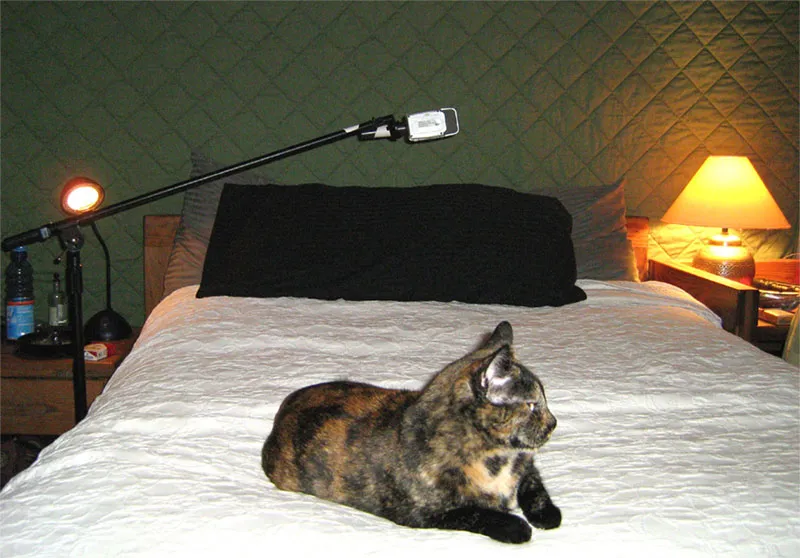
Photo: ThornDaddy, CC BY-SA 3.0, via Wikimedia Commons
On a Burbank stage in early 2026, a living room set is getting a very un-living-room test. The cameras are off. A production designer is tapping a bookshelf to hear how hollow it sounds. A audio mixer is walking the rug line with a boom pole, listening for the spot where a host’s voice will bounce off the window frame. An electrician is swapping a practical lamp for a dimmable bulb that can look like late afternoon on camera and like a warm conversation corner on a podcast feed.
This is what a companion-audio build looks like now. The room is not just a location anymore. It is a piece of content infrastructure.
The New Triple-Threat Room
For years, the companion podcast was the thing a show made after the cameras stopped—two hosts, a borrowed conference room, a couple of dynamic mics, and a hard out before the next production moved in. In 2026, more shows are planning the podcast at the same time they plan the set. The room has to work as a scripted location, a press-junket backdrop, and a podcast studio. Sometimes all three happen within 72 hours.
“We used to design for the frame,” says Elena Ruiz, a production designer who has built three such rooms this year. “Now we design for the frame and the waveform. If a wall looks great but makes a host sound like they’re inside a shoebox, it’s the wrong wall.”
The result is a set that looks familiar on screen but behaves differently behind the scenes. Bookshelves are built with removable absorptive panels behind the spines. Curtains are heavier than they appear. The coffee table is sized so a pair of tabletop mics can sit just outside the camera’s tightest shot. Even the rug has a job: it kills the slapback from a hard floor without looking like a recording booth.
Acoustic Treatment Is Now Set Decoration
The most visible change is also the quietest. Acoustic treatment has moved out of the utility closet and into the art department. On a recent build, Ruiz’s team used perforated wood panels disguised as wainscoting, a fabric-wrapped banquette that doubles as a bass trap, and a ceiling cloud tucked above a practical light fixture. None of it reads as “studio” on camera. All of it reads as “this room sounds better than it has any right to.”
Audio teams are being pulled into design meetings earlier, too. Dae Kim, a production sound mixer working on a half-hour comedy with a companion interview show, says he now gets a walk-through before the set is painted. “I’m not there to make it look ugly,” Kim says. “I’m there to say, ‘That glass coffee table is going to be a problem for the podcast version,’ or ‘If you put the host chair there, the HVAC vent is going to eat every pause.’”
The fixes are often small. A felt backing behind a picture frame. A softer window treatment. A different lamp shade that doesn’t buzz. But they add up to a room that can handle a scripted scene at 9 a.m. and a two-host conversation at 4 p.m. without a full rebuild.
Scheduling the Podcast Between Setups
The scheduling is where the companion-audio boom really shows up. A typical day on one 2026 production looks like this: main unit shoots scripted scenes from 7 a.m. to 3 p.m.; the podcast setup rolls in from 3:15 to 4; hosts record two companion episodes from 4 to 6; the room is struck back to its scripted look by 7. The next morning, a press stop uses the same corner with a different backdrop and a lav mic hidden in a jacket.
That kind of turnaround only works if the set is designed for it. The production designer and the audio team create a “reset map” that shows which practicals move, which panels stay, and which furniture gets swapped. The art department keeps a rolling cart of podcast-specific props—a different side table, a pair of mics, a small monitor—so the room can shift identity without a full dress.
“It’s less about building two sets and more about building one set with two personalities,” Ruiz says. “The podcast personality is just the same room with the lights lowered and the mics closer.”
Crew Roles Blur in the Best Way
The build-out is also changing who talks to whom. Set dressers now get notes from the audio team about reflective surfaces. Gaffers learn which practical lamps need to be flicker-free for camera and quiet for recording. The location sound mixer, once a day-of hire, is sometimes consulted during prep. And the podcast producer—who used to show up after the shoot wrapped—now sits in on production meetings to understand what the room can and cannot do.
Kim says the biggest adjustment is communication. “On a normal show, I’m the guy who shows up and says the room sounds bad,” he says. “On this show, I’m the guy who gets to say it before the room is built. That’s a much better job.”
It is not always smooth. Companion audio adds time to the schedule, and time is the thing no production has enough of. But crews are finding that a little planning up front saves a lot of apologizing later—especially when a host has a cold, the HVAC is loud, or a press stop runs long and the podcast has to record in a corner of the stage while the next scene is being lit.
Marketing Between Episodes
The business reason is simple: shows need to stay alive between episodes. A companion podcast gives audiences another way in, and it gives the marketing team something to post when the main show is dark. The same room that appears in the scripted series can appear in a YouTube clip, a behind-the-scenes drop, or a podcast cover shoot. The set becomes a brand asset, not just a location.
That is why the room is being designed to look good in a vertical video, too. Conversation lighting is softer and more frontal than scripted lighting, because a host’s face needs to read on a phone screen. The background has to be interesting but not busy. The mics have to be visible enough to signal “podcast” but not so visible that they ruin the scripted look.
“The audience doesn’t think about acoustic panels,” Ruiz says. “They think, ‘That room feels warm.’ But the warmth is doing two jobs. It’s the look, and it’s the sound.”
What to Watch For
The companion-audio build is still a work in progress. Some shows are treating it as a permanent part of the stage; others are renting modular podcast kits that can be dropped into any set. Either way, the direction is clear: the podcast room is no longer a separate room. It is a set, a schedule, and a marketing plan all at once.
And if the room looks like it has always been there? That is the point. The best companion-audio builds are the ones where the audience never notices the engineering—just two people talking in a space that feels like it was made for them.