Every Feed Gets a Different Show: Inside the 2026 Trailer-Splitting Desk
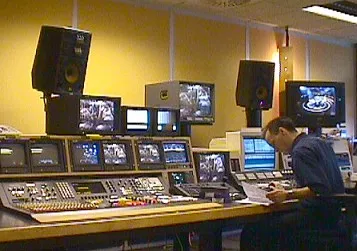
Photo: Channel R at English Wikipedia, Public domain, via Wikimedia Commons
On a Tuesday morning in Burbank, a trailer editor named Dana has forty timelines open. Not forty episodes. Forty promos for one season of one show. There is a 60-second teaser for connected TV, a 15-second vertical cut for TikTok, a spoiler-light version for a partner platform, a talent-approved version with a different music cue, and a version for an airport screen that has no sound and less than nine seconds to make sense. Dana calls the whole pile “the tree.” Everyone else calls it Tuesday.
This is the 2026 marketing bay, where a season is no longer sold with one trailer and a poster. It is sold with a matrix. The same show has to work as a full-screen drama, a vertical hook, a muted autoplay ad, a pre-roll bumper, and a thumbnail that has to survive being the size of a stamp. The result is a production problem disguised as a marketing one — and the people solving it sit somewhere between the edit bay, the clearance desk, and the showrunner’s inbox.
The First Teaser Is Not the Trailer
For the fictional drama “Harbor Lights,” the campaign starts long before the final trailer. The first asset is a 45-second teaser built for YouTube and streaming home screens. It opens on a ferry at dawn, holds a shot of a character’s face for exactly four seconds, and ends on a title card with a date. That cut is not the trailer. It is a mood test. It tells the platform teams what footage exists, what can be shown, and what the showrunner is willing to spoil in October for a January launch.
From there, the bay builds families. There is the date-announce spot, the character spot, the critics’ spot, the “from the executive producer of” spot, and the international version that removes a shot of a US landmark because the show sells differently overseas. Then come the platform cuts: 16:9 for YouTube, 4:5 for feed placements, 9:16 for vertical, 1:1 for a retailer promo, and a six-second bumper that has to land before the skip button appears. None of these are afterthoughts. The vertical cut gets its own edit, its own sound mix, and its own first two seconds.
Forty Is Not a Typo
“Forty versions” sounds like an exaggeration until you see the asset sheet. The sheet is a grid: platform, length, aspect ratio, spoiler tier, talent approval status, music status, caption status, and delivery date. Some versions are simple reformats. Others are genuinely different cuts with different openings, different pacing, and different end cards. A 30-second cut for a streaming service may lead with the mystery. A 15-second cut for a social feed may lead with the most recognizable face and a line of dialogue that reads as a caption before the sound turns on.
The editor’s job is not to make forty original trailers. It is to keep forty versions from becoming forty different shows. Dana keeps a “bible” for each campaign: the approved shot list, the no-go shots, the music cues that are cleared, and the lines that talent has signed off on. When a new version is requested — say, a 20-second cut for a fitness app’s ad rotation — the bay does not start from scratch. It pulls from the approved families and rebuilds the spine.
That is where the marketing bay starts to look like a scripted production. There are version-control meetings, color-coded timelines, and a post producer whose entire job is to know which cut is the current cut. “We used to ask, ‘Which trailer are we running?’” says one marketing producer on the campaign. “Now we ask, ‘Which trailer, for which placement, in which language, and did legal see the last frame?’”
The Spoiler Ledger
The spoiler conversation is the most delicate part of the desk. Every shot in a season gets a tier: safe for teaser, safe for trailer, safe only after launch, or never in marketing. A death, a kiss, a returning character, a location that reveals the twist — all of it gets logged. The showrunner signs off on the tiers, but the trailer editor is the one who has to enforce them at 11 p.m. when a platform asks for a “more emotional” cut and the most emotional shot is also the one that ruins episode six.
Clearance adds another layer. Music cues have to be cleared for every length and every platform. Footage from a partner brand cannot appear in a competitor’s ad slot. A background painting that was fine in the episode may be too readable in a freeze-frame thumbnail. The marketing bay keeps a clearance producer on speed dial, and the clearance producer keeps a spreadsheet that looks like an air-traffic control board.
Vertical Is a Different Language
The vertical cut is not a crop. That is the first thing every editor says, and the second thing they say is that nobody believes them. A 9:16 promo needs a new grammar. The first two seconds have to work without sound. The text has to sit inside the safe zone. The faces have to be close enough to read on a phone, but not so close that the show looks like a different genre. The sound mix has to survive a tiny speaker and a noisy train car.
For “Harbor Lights,” the vertical team built a separate 12-second cut that opens on a hand slamming a door, then cuts to a face, then to a title card. The full trailer opens on a wide shot of the harbor. Same season. Different first impression. The marketing team tests both, but not in a traditional test-screening way. They watch retention curves, completion rates, and the point where viewers swipe away. The data does not write the cut, but it tells the bay where the cut is losing people.
Who Signs Off
By the time a final spot is delivered, it has passed through the showrunner, the studio marketing team, the platform’s standards group, talent approvals, and legal. Each pass can add a note. Each note can spawn a new version. The bay’s calendar is built around approval windows, not edit sessions. A 30-second cut may take two days to edit and two weeks to sign off.
That is the real forty-trailer problem. It is not that editors cannot make forty cuts. It is that every cut needs a paper trail, and every paper trail needs a person who knows which version of the season the audience is allowed to see first. The trailer bay does not decide the campaign. It negotiates it, frame by frame, until the show is ready for every feed at once.